
[Part 4] Production Database Migration or Modernization: A Comprehensive Planning Guide

The fourth part of our multi-post guide discusses common complications in production migrations as well as general best practices to ensure success of your project.
If you haven't read the first three parts, read them here:

7. Common Complications and Mitigation
Expect the unexpected. These complications appear in nearly every migration.
Legacy Code Dependencies and Technical Debt
Codebases evolve over years, accumulating assumptions about database behavior. Stored procedures that seemed convenient become migration blockers. Undocumented business logic embedded in database triggers must be reimplemented. Tackle technical debt incrementally during the dev phase rather than attempting a big-bang refactor.
Lack of Code Documentation and Dependencies
The engineer who wrote critical data access code left years ago. Documentation is sparse or outdated. Untangling dependencies becomes archaeological work. Budget extra time for discovery and invest in documenting what you learn. For complex environments, try to execute a production dry-run as early as possible - that's where you'll learn the most.
Database or Network Issues During Ingestion
Network partitions, connection timeouts, and resource exhaustion can interrupt migration. Design for resilience and choose tools with retry logic, checkpointing to resume from failure points, rate limiting to avoid overwhelming source or target, and monitoring to detect issues quickly.
Tool Permissions and Access Control
Migration tools need appropriate permissions on both source and target databases. In enterprise environments, obtaining these permissions through security review processes can take weeks. Address access requirements early.
Data Model Incompatibilities and Transformations
Migrating from relational to NoSQL requires fundamental thinking shifts. Joins become embedded documents or separate queries. Transactions have different semantics. Carefully design your target schema and test transformations thoroughly with realistic data. When performing a dry run, test all the critical workflows to ensure that queries are executed efficiently.
Integration Dependencies
Your database isn't isolated. Data pipelines, reporting systems, third-party integrations, and internal tools all depend on database structure and availability. Catalog all dependencies early and coordinate changes across teams.
Performance Degradation During Migration
Migration processes can saturate network bandwidth, max out CPU on source or target databases, and impact production workloads. Rate-limit your migration, schedule intensive operations during low-traffic periods, and monitor impact continuously.
Unexpected Data Quality Issues
Old databases accumulate data quality problems: inconsistent formats, orphaned records, violated constraints that aren't enforced, and edge cases in data types. These issues commonly surface during production dry runs when you encounter the full diversity of production data. Build data filtering and transformation logic to handle these scenarios.
DNS
If nothing else, it's almost certain that DNS issues will haunt you in your production environment during the migration. Rehearse and test all the related changes ahead of time.
8. Best Practices
Learn from our decade-long experience as well as the collective experience of the industry.
Comprehensive Testing in Non-Production Environments
Test everything, repeatedly, in environments that mirror production. Automate tests so they can run frequently without manual effort. Include not just happy paths but failure scenarios and edge cases.
Incremental Migration When Possible
Reduce risk by breaking large migrations into smaller chunks. Migrate less critical data or services first to refine your process. Each successful increment builds team confidence and improves procedures.
Complete Production Dry-runs
There's nothing closer to your production than... your production. Do a dry-run, or two. A dry-run is a complete execution of your migration, including application re-deployment, but without the cut over. Don't skip steps. Turn this into a well-planned and rehearsed activity, to avoid rollercoasters on the day of.
Automated Validation Scripts
Manual data comparison doesn't scale. Choose tools or build robust automation that can validate millions of records quickly and accurately. These scripts become invaluable assets for future migrations and ongoing data quality monitoring.
Clear Rollback Procedures
Hope for the best, plan for the worst. Everyone involved should understand exactly what triggers a rollback and what steps to execute. Practice rollback procedures during dry runs.
Documentation and Runbooks
Document your architecture, data transformations, migration procedures, and operational playbooks. Document the step-by-step project plan. This documentation helps during the migration and becomes institutional knowledge for operating the new system.
Post-Migration Performance Tuning
Your initial migration focuses on correctness. After cutover, optimize based on real production query patterns. Add indexes, adjust configurations, and refine your data model based on actual performance metrics.
In our next and the last post in this series we will showcase a sample project plan and will discuss the key lessons.
Contact us for help with production migrations.
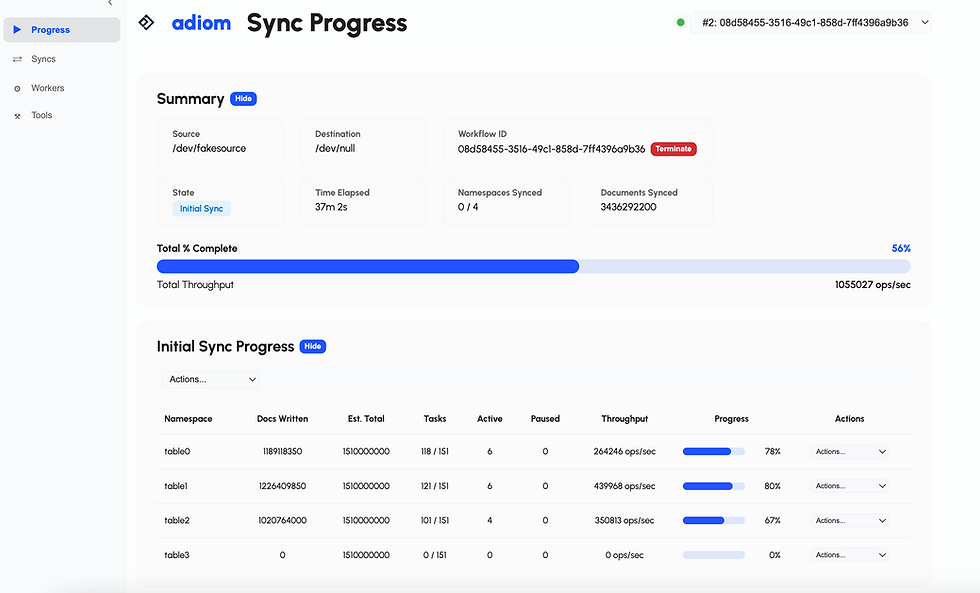
Download and try Dsync for your migration here. We built it to make your migration experience seamless.

Comments