
Announcing DocumentDB support: an Open Source MongoDB compatible Database


At Adiom, we firmly believe in the power of true Open Source Software to advance the ecosystem and enable unhindered innovation. We're excited to announce full Azure DocumentDB support as a source and as a destination, including the managed and the self-hosted versions.
Azure DocumentDB is built on PostgreSQL and uses custom extensions for enabling MongoDB compatibility. It lacks certain features, namely Change Streams, and in general can be considered as lagging several versions behind MongoDB's main branch, but with AWS and Microsoft joining forces on this one, we believe that the gap will start shrinking quickly.
While AWS already has a product with the same name that has MongoDB compatibility, Microsoft took a very different approach and invested in their solution becoming a contribution to OSS and Linux Foundation.
If you want to replicate or migrate your database to DocumentDB from MongoDB or another database, the process is as seamless as a single command, whether you have 100 documents or 1 billion:
dsync $SOURCE_URI $DOCUMENTDB_URIIf you want to see progress in your CLI rather than the Web version:
dsync --progress --logfile dsync.log $SOURCE_URI $DOCUMENTDB_URIMore options and supported sources can be found in our documentation.
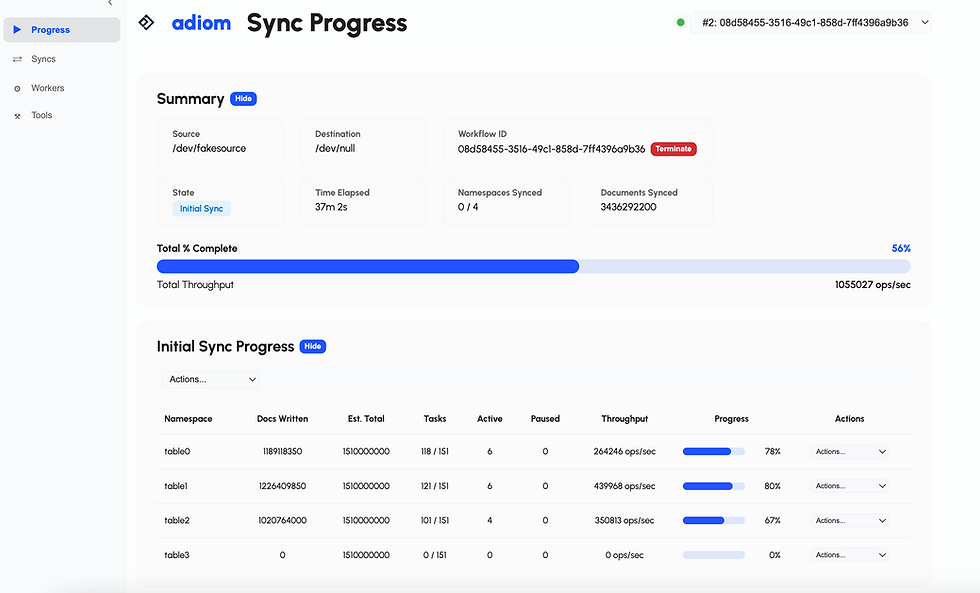
Dsync takes care of parallelization, write batch optimization, reporting and automatically coordinating real-time CDC data capture with the initial data snapshot while maintaining data integrity. For large (>100GB) and mission-critical deployments, Dsync has a horizontally-scalable Enterprise version that features resumability and OpenTelemetry-compatible observability.
Note that for a MongoDB source to work with CDC, it needs to be a replica set or a sharded cluster. Otherwise you can pass the "--mode InitialSync" option to dsync to skip CDC.
Read more:
Try dsync:

This seems pretty useful, I'm curious can you choose to just sync a single collection or two?