
Mission-Critical DB Migrations Are Heart Surgery. Treat Them That Way.

Most engineering teams wildly under- or overestimate what a large database migration actually takes. Here's the honest picture - and why the right tooling is the difference between months and years.
Two Wrong Opinions, One Real Problem
Ask an engineering or business unit leader what a database migration involves and you'll almost always land on one of two extremes. Either they think it's trivially easy - "just run it once in production" - or they treat it as some mythical, unknowable risk that gets endlessly deferred. In both cases, the result is the same: the can gets kicked down the road.
"Just run it once in production" is not a migration strategy. It's a hope dressed up as a plan.
The misconception is partly understandable. Most leaders have only witnessed a handful of migrations in their careers, if any. And the range of what "a migration" can mean is enormous - which is exactly where the confusion starts.
Small Migrations vs. Mission-Critical Ones
Not every migration is equal. Small migrations - think under 100GB for non-critical internal services like dashboards or analytics tools - are genuinely fast and low-risk. They can often be completed in a single day with minimal preparation and even less organizational anxiety. These are routine procedures.
Large migrations for revenue-generating, customer-facing systems are something else entirely. They are, without exaggeration, like heart surgery. The stakes are high. Precision is non-negotiable. And the confidence to execute comes not from luck or seniority, but from the ability to consistently and repeatably run the process in production - with the right instruments in hand.
There's a reason surgical teams don't operate with improvised tools. A scalpel alone, versus access to a da Vinci Xi robotic system, represents not just a difference in capability but a difference in the outcomes that are even possible. The same logic applies here.

What a Live Production Migration Actually Requires
To execute a live database migration in production without taking your system offline, you need to coordinate a surprising number of moving parts simultaneously:
Parallelize data copy - copying terabytes sequentially is impractical; concurrency is essential.
Coordinate initial sync and CDC - Change Data Capture must seamlessly bridge the gap between the initial snapshot and live writes.
Maintain data integrity - every row must land correctly, every relationship intact, every constraint respected.
Be able to rollback - if something breaks, you need a clean, practiced path back. No improvising at 2am.
Account for source and destination specifics - edge cases, encoding differences, type mismatches, and engine-specific behaviors all need handling.
Handle legacy and "ghost" records - production databases accumulate years of orphaned rows, deprecated schemas, and soft-deleted data that can break assumptions.
None of this is optional. Miss any one of them and you risk data loss, extended downtime, or a failed cutover window with the entire business watching.
What Good Tooling Provides
✓ Resumability | ✓ Data integrity checks |
✓ Observability | ✓ Transformations |
✓ Security | ✓ Ease of use |
✓ Scalability | ✓ Extensibility for schema changes |
Repeatability Is the Real Metric
Perhaps the least intuitive part of a major migration project is how many times you need to run the full process before you actually touch production for real. The answer is: a lot.
First, the migration runs repeatedly in lower environments - dev, staging, UAT - to calibrate the process, catch edge cases, and establish baseline performance metrics. These runs let you extrapolate how long the production migration will take and what can go wrong. Then come production dry runs: full end-to-end rehearsals, everything except the final cutover flip.
Cutovers themselves are tightly choreographed events. They happen during off-peak windows, require all hands on deck, and are followed by stabilization periods of at least one to two weeks where the team monitors closely for regressions. Business units can only offer these windows a few times a year. There's no wasted attempts budget.
The repeatability and predictability of your migration tooling essentially define how long the project takes - and when you can actually cut over.
Why We Built Dsync
Dsync is our answer to the question: what does the robotic surgical platform look like for database migrations? It's not a one-click migration service - the expertise and decision-making still lives with your team. But it meaningfully changes the probability of a successful outcome and compresses the timeline from something measured in calendar years to something measured in weeks.
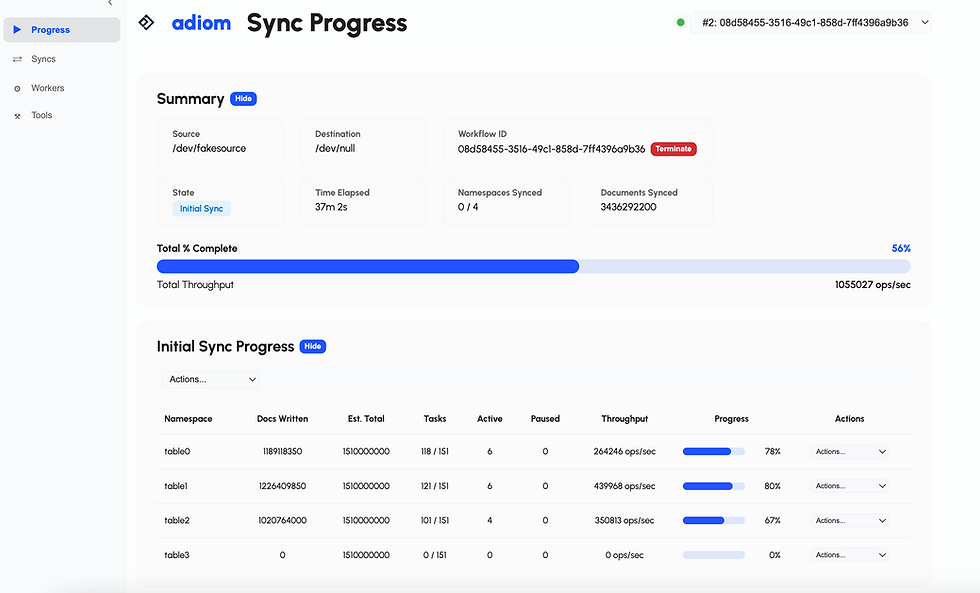
Before you can commit to a large migration project, you need months of feasibility assessment just to answer whether it's even possible and what risks you're taking on. Dsync shortens that runway significantly, giving teams the observability, resumability, and integrity checks needed to build confidence fast - and the extensibility to handle whatever surprises your production schema has been hiding for the last decade.
We're working toward a more automated future. But even today, having the right platform under you is the difference between a migration that drags on for a year of organizational anxiety and one that's done before the next planning cycle.

Comments