
One Database Is a Liability: Splitting Tenant Data Across Clusters Without Losing Your Mind

A single shared database is the easiest way to start a multi-tenant product - and one of the fastest ways to back yourself into a corner. As you scale, four forces pull your data apart: compliance, locality, quality of service, and blast radius. This is how to architect for that split, and how to move tenants between clusters when - not if - you have to.
Why One Cluster Stops Working
In the beginning, every tenant lives happily in one database. It's simple, it's cheap, and it's exactly the right call. But growth has a way of turning that simplicity into a constraint. Sooner or later, four distinct pressures show up - usually all at once - and none of them are solved by buying a bigger box.
Compliance | A healthcare customer needs their data isolated under HIPAA. An EU customer's records can't leave the EU under GDPR. A government tenant needs a sovereign environment entirely. "Just add a tenant_id column" doesn't satisfy an auditor who wants hard isolation boundaries. |
Locality | Your tenant in Sydney shouldn't pay a 200ms round-trip to a database in Virginia. Latency is a product feature, and the only way to fix it is to put data physically close to the users who read and write it. |
Quality of Service (QoS) | One enterprise tenant runs a runaway analytical query and suddenly everyone shares the pain. Noisy neighbors are inevitable in a shared cluster. Dedicated or pooled clusters let you guarantee performance tiers and stop one tenant from degrading the rest. |
Blast Radius | A bad migration, a corrupt index, a failover gone wrong - in a single cluster, that's an incident for every customer at once. Partitioning tenants across clusters means a failure is contained to a slice of your business, not all of it. |
The goal isn't more databases for their own sake. It's the ability to draw isolation boundaries on purpose, where the business actually needs them.
The Architecture: Five Components That Make It Work
A regional, multi-cluster, multi-tenant system isn't one big piece of software - it's a handful of components that each do one job well. Get these five right and the rest is detail.

1. Application-level routing
The router is the brain. Every request carries a tenant identity, and the application layer maps that identity to the right cluster - tenant → cluster - before any query is issued. This map is the source of truth for where a tenant's data lives. It needs to be fast, cached close to the application, and - critically - updatable at runtime, because the day you move a tenant, the router is what makes the cutover real. Routing at the application layer, often as a service side car (rather than relying on a database-side proxy), keeps the logic explicit, testable, and tied to your domain's notion of a tenant.
2. Database clusters
These are the homes for your data: a fleet of clusters partitioned by region, compliance regime, or service tier. Some are pooled (many small tenants sharing a cluster for cost efficiency), some are dedicated (one large or sensitive tenant per cluster). The architecture has to treat clusters as interchangeable destinations - provisionable, decommissionable, and addressable by the router - rather than hand-tuned pets.
3. Data mover
This is the component most teams underestimate, and it's the reason this post exists. Tenants don't stay put. They outgrow their pooled cluster, change compliance requirements, or need to move to a new region. The data mover is what relocates a tenant's data from one cluster to another - ideally live, with the tenant's application still serving traffic the whole time. Without it, every one of the four pressures above eventually becomes a wall you can't get past.
4. Observability
With data spread across many clusters, "is the system healthy?" becomes a per-cluster, per-tenant question. You need unified visibility into cluster load, per-tenant resource consumption, replication lag, and the progress and integrity of any in-flight migration. Observability is also what tells you when to move a tenant - it's the signal that a cluster is getting hot or a neighbor is getting noisy.
5. Control panel
The control panel is the operator's cockpit: provision a cluster, place a tenant, kick off a migration, watch it land, update the routing map, and decommission what's empty. It turns a set of powerful-but-dangerous primitives into repeatable, auditable operations. The better the control panel, the less every tenant move depends on one engineer remembering the runbook.
"But MongoDB Already Has Sharding" - Why That's Not the Same Thing
If you're on MongoDB, the database can shard for you. Why run twelve independent replica sets behind an application-level router when you could run one 12-shard cluster and let the balancer spread tenants across shards automatically (using sharding tags)? Both spread data across twelve sets of hardware. They are not the same architecture.
A single sharded cluster is one logical database. That's the whole point of it - and also the catch. A 12-shard cluster shares config servers, a balancer, a version, and a maintenance window across all twelve shards. Twelve replica sets with app-level routing are twelve genuinely independent databases that happen to be coordinated by your application.
12-shard cluster | 12 replica sets + app routing | |
Blast radius | Shared config servers and balancer - a control-plane problem can affect the whole cluster | Each replica set fails on its own; one going down touches only its tenants |
Compliance / locality | One cluster, typically one region and one trust boundary | Put each replica set in its own region or compliance regime, independently |
Upgrades & maintenance | Version and maintenance windows are cluster-wide | Upgrade or patch one tenant's database without touching the rest |
Tenant placement | The balancer decides and moves, by shard key and tags - not by your business rules | You place tenants explicitly, by tier, region, or contract |
Moving a tenant | Chunk migration within one cluster; can't move a tenant to a different region or trust boundary | A data-mover job relocates a tenant to any other cluster, anywhere |
Native sharding is excellent at what it's for: scaling a single dataset horizontally when you don't need isolation between the rows. But the four pressures in this post - compliance, locality, QoS, and blast radius - are all about drawing boundaries, and a sharded cluster is deliberately built to erase them. App-level routing over independent clusters keeps you in control of where each boundary sits. The trade is that you now own the routing map and the tenant moves yourself - which is exactly why the data mover matters.
Sharding spreads one database wider. App-level routing across independent clusters gives you many databases you can place, isolate, and move on purpose.
The Hard Part: Migrating Big Tenants, Live
Here's the irony at the center of multi-tenant operations. You almost never need to move a tenant when they're small and easy. You need to move them precisely when they've become big - hundreds of gigabytes or more - and important, and busy. The migration you can't avoid is also the one that's hardest to pull off.
And the constraints stack up fast. A tenant migration in a live multi-tenant system has to satisfy all of these at once:
Minimal interruption of service. The tenant is in production. You don't get to take them offline for a weekend.
Automated or semi-automated. If every move requires an engineer babysitting a UI for eight hours, you'll never do it often enough to keep up.
Filtered at the source. You're moving one tenant out of a shared cluster - not the whole database. The mover has to select just that tenant's data, cleanly.
Into a non-empty destination. The target cluster already hosts other tenants. You're merging into a live dataset, not restoring into a blank slate.
Carefully throttled. The source cluster is still serving every other tenant. A migration that saturates I/O turns one tenant's move into everyone else's outage - exactly the blast radius you were trying to avoid.
Now look at what most data migration tooling actually assumes:
Most migration tools expect… | Multi-tenant reality |
Dedicated infrastructure you provision and babysit | You want it to run as a job on infra you already have |
A one-shot bulk copy, no live changes without complicated setup | The tenant keeps writing throughout |
An operator clicking through a UI | You need it scripted and repeatable |
An empty destination | The target already has tenants on it |
Migrate the whole dataset | You need to filter to one or several tenants at the source |
Run flat-out, as fast as possible | You must throttle to protect production neighbors |
Standard migration tools are built for the empty-to-empty, take-it-offline, click-the-button case. Multi-tenant migrations are none of those things.
How We Solved It: Dsync as the Data Mover
For one of our customers running exactly this kind of regional multi-tenant platform, we used Dsync as the data mover - and it lines up against the constraints above point for point. Dsync was built for live production migrations, which is precisely what a tenant move demands:
Live migration. Initial sync plus change data capture, so the tenant keeps serving traffic while their data moves. The cutover is a routing-map flip, not a downtime window.
No specialized infrastructure. Dsync runs as Kubernetes jobs on the cluster you already operate - nothing extra to provision, secure, and tear down for every move.
Source-side filtering. Move exactly one tenant's data out of a shared cluster, instead of the entire dataset.
Merges into non-empty destinations. Land a tenant on a cluster that's already serving other tenants - the realistic case, not the demo case.
Load-level throttling. Cap the migration's footprint so the source cluster keeps its performance promises to every other tenant on it.
Fast and resumable. Parallelized copy for hundreds of gigabytes, and if something interrupts a run, it picks up where it left off instead of starting over.
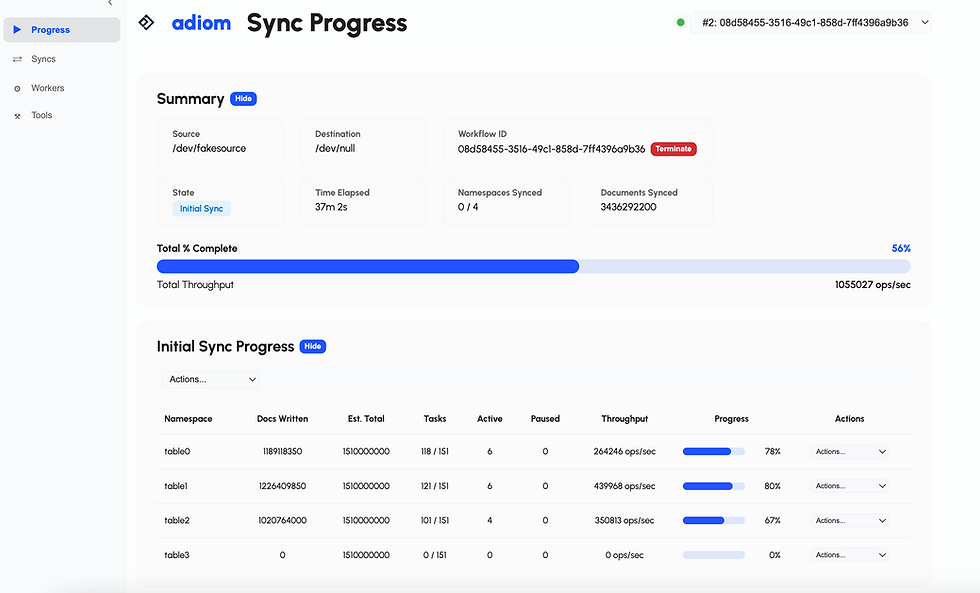
Observable and secure, with embedded validation. You can watch progress and lag in real time, and Dsync verifies data integrity as part of the move - so you cut over on evidence, not hope.
The result is a tenant migration that behaves like a routine operation instead of a heart-surgery event: filtered at the source, throttled for the neighbors, merged into a live destination, validated end to end, and finished with a routing flip - all without standing up a parallel migration stack.
Building a regional multi-tenant system?
If you're building - or planning to build - a regional, multi-tenant data platform, the data mover is the component that decides whether your architecture can actually evolve. Check out Dsync for tenant data mobility, and reach out if you want help with tenant migrations - we've done this in production and can help you do it too.

Splitting database clusters for multi-tenant setups usually spirals into a UI workflow mess once frontend teams try supporting custom tenant features. I mean, the backend architecture fix is clean, but syncing design systems across isolated environments gets chaotic fast. Honestly, I feel like bringing in designops consulting for enterprise setups helps align product teams so devs and designers aren't constantly re-architecting components for every cluster